Image Costanza Di Patrizi

The Space between Assumption and Experience

About Me

Hello everyone, my name is Costanza Di Patrizi, and I am a first-year PhD student at the University of Antwerp in the Department of Family Medicine and Population Health, within the Research Group on Social Epidemiology and Health Policy.

After completing my studies in Political Science and Sociology, I spent three years working on social inclusion projects in the field of addiction, and I am now contributing to the Horizon Europe project ENDEAVOR.

ENDEAVOR seeks to improve treatment and surveillance strategies for patients with Barrett’s esophagus and early esophageal adenocarcinoma. In this project, my research focuses on assessing health-related quality of life and promoting patient-centered care, aiming to integrate patients’ perspectives into clinical decision-making and evaluation.


The Platinum Rule

The ENDEAVOR project was designed with several aims in mind: (1) to reduce healthcare costs, (2) to improve the satisfaction of healthcare providers, and – above all – (3) to enhance patients’ well-being.

The starting point was clear: despite advancements in endoscopic treatments such as EMR, ESD, and RFA, which enable early intervention in the initial stages of esophageal adenocarcinoma (EAC), it is currently impossible to predict which Barrett’s Esophagus (BE) patients with early-stage cancer will respond completely to endoscopic therapy and remain in long-term remission, and which will experience recurrence. As a result, all treated BE patients must undergo frequent endoscopic surveillance, resulting in overtreatment of more than 90% of patients and potential undertreatment of the small group with more aggressive disease.

The logic seemed straightforward: if a new risk stratification model could safely reduce the frequency of endoscopic procedures, patients’ quality of life would improve. Until, once the project had been approved and funded, during the 2025 annual project meeting (the second overall, but my first, as I had joined ENDEAVOR in its second year), a patient candidly told us that he was actually happy to undergo endoscopic procedures.

A brief moment of bewilderment and bemused laughter followed, making us wonder whether we had misunderstood everything. In fact, fortunately, this did not undermine the robustness of our project, but it did prompt us to reflect on an aspect we had perhaps underestimated before. That moment served as a valuable reminder: patients’ experiences – like anyone’s lived experience – are not always easily predictable or intuitively understood. In this regard, one of my professors at university, the sociologist Milton J. Bennett, used to discuss the limits of the traditional “Golden Rule”, which tells us to “treat others as we would want to be treated”. This rule is based on an assumption of similarity between ourselves and others, leading us to suppose – arbitrarily – that others are like us and therefore wish to be treated as we would wish to be treated.

As a more accurate alternative, Bennett formulated what he called the “Platinum Rule” (Figure 1): “Treat others the way they want to be treated”.


Figure 1. The Golden Rule versus the Platinum Rule by Milton J. Bennett 


This marks the passage from sympathy to empathy.It emphasizes the importance of understanding and respecting people’s individual preferences, communication styles, and needs, acknowledging that everyone has different worldviews and that a personalized approach is more effective in both relationships and care provision. I would also add a matter of justice: people should be actively involved in decisions that directly affect their lives. This relates to what is called epistemic justice – the recognition of knowledge derived from lived experience – which should be valued even when decisions are guided by recognized professional expertise, such as in medicine. As the disability rights movement has long reminded us: “nothing about us without us”. This slogan, which emerged in the 1960s and 1970s to challenge paternalistic approaches and promote self-determination, remains highly relevant in modern healthcare.


Reconsidering Quality of Life in Clinical Practice

Interestingly, a recent longitudinal study by Qiu et al. (2024) on patients with esophageal cancer who underwent curative resection found that certain changes in patient-reported quality of life (QoL) were independently associated with overall survival. In other words, the study observed that QoL measured at specific time points provided unique prognostic information beyond traditional clinical data.

The association between quality of life and survival has been observed across various cancer types, but evidence in esophageal cancer is still emerging, making this study particularly noteworthy. Within this context, most research has focused on functional and symptomatic outcomes, especially after surgery. The findings by Qiu et al. provide empirical evidence that changes in patients’ well-being over time can be linked to prognosis – highlighting the importance of monitoring QoL longitudinally to support timely and more responsive care.

Conceptually, this connection is consistent with the well-established biopsychosocial model of health, which recognizes the interplay between biological, psychological, and social factors in shaping well-being, as well as with the World Health Organization’s definition of health as a state of complete physical, mental, and social well-being.


My Work within ENDEAVOR

Within ENDEAVOR, my PhD research focuses on understanding how surveillance and treatment for early esophageal adenocarcinoma affect patients’ lives and well-being.

Currently, our team is conducting a systematic literature review to summarize what is known about patient-reported outcomes and experiences (PROMs/PREMs) in different models of surveillance and care for individuals at risk of or treated for early esophageal adenocarcinoma. The review aims to identify patterns and gaps in how patients experience care, helping to inform improvements in surveillance practices.

We have also completed the linguistic and cultural adaptation of the Cancer Worry Scale (CWS), and its validation in this new clinical context will follow. During the upcoming RCT, patients will complete questionnaires – including the EQ-5D-5L and the Cancer Worry Scale – to help us assess the impact of the new risk stratification model, particularly the disclosure of individual risk profiles, on patients’ quality of life. Healthcare professionals will also be asked to complete a questionnaire to assess their satisfaction and perspectives on surveillance practices.

Finally, we will conduct interviews and focus groups with a sample of patients and key stakeholders to explore in depth the experiences, meanings, and expectations surrounding endoscopic surveillance.

As we move forward, I often think back to that patient’s honest comment and to Bennett’s “Platinum Rule”. Recognizing that patients may not always feel as we imagine they do – and understanding how they make sense of their illness and care – is not a complement to clinical science, but an essential part of it.


Costanza Di Patrizi

Nastaran-Riahi b&w

From Bench to Bedside: My PhD Journey with ENDEAVOR and Universal Diagnostics

About Me

Hello everyone, my name is Nastaran Riahi. I am a PhD Candidate in Oncology at the University of Antwerp and a Clinical Researcher at Universal Diagnostics (UDX).

When I joined UDX five years ago as a cancer researcher, I was captivated by a simple, powerful idea: could a routine blood test help us detect cancer and its precursors early enough to change someone’s story? That question led me to pursue my  PhD at the University of Antwerp within the ENDEAVOR project, under the supervision of Prof. Dr. Krishnadath, who leads this European initiative. ENDEAVOR is a five-year, EU-funded collaboration bringing together 15 academic partners, two general hospitals, and UDX as an industry partner. Our shared goal is to translate that “simple blood test” idea into practical tools for people living with Barrett’s esophagus (BE).


Why Barrett’s Esophagus and Why Now?

Esophageal cancer is one of the deadliest cancers worldwide because it’s often found late and behaves aggressively. Esophageal squamous cell carcinoma (ESCC) and esophageal adenocarcinoma (EAC) are the two most common histological subtypes of EC. Over four decades, the frequencies of EAC and BE, the known precursor lesion for EAC, have sharply increased in North America and Europe. Despite early detection and endoscopic therapy, the patient’s clinical course remains difficult to predict. That uncertainty means many patients undergo frequent, invasive endoscopies. Since no other modality of surveillance is currently available. We can do better.


ENDEAVOR’s goals

ENDEAVOR aims to build smarter risk-stratification for BE: helping clinicians see earlier and more precisely, who is likely to progress and who will respond well to treatment. The vision is personalized prevention, directing the right treatment at the right time and tailoring follow-up so patients avoid unnecessarily invasive procedures while remaining cancer-free.


My Project in a Nutshell

My PhD focuses on whether a multi-omics approach combining DNA methylation signals in blood with genetic mutations identified in tissue can predict how BE patients respond to endoscopic therapy and who is at the highest risk for EAC. In practical terms, I analyze cell-free DNA (cfDNA) from blood samples taken before and after endoscopy treatment, using targeted methylation sequencing developed at UDX. Then, with the ENDEAVOR collaborator, I integrate those data with matched tissue mutation profiles. The hope is to create a robust set of biomarkers that distinguishes responders from non-responders to treatment and guides clinical decisions.


Why Methylation?

Among many potential biomarkers, aberrant DNA methylation has emerged as one of the most promising for monitoring BE and detecting EAC early. By reading methylation changes in cfDNA, we may capture a real-time picture of tumor biology from a simple blood draw. Pairing that with mutation data can reveal how genetics and epigenetics work together during disease progression and how they respond to treatment.


How We’re Doing It

  • 1. Who we study: In the pilot study, approximately 50 patients with high-grade dysplasia (HGD)/ early EAC are at the highest risk for progression.
  • 2. When we sample: Two time points, before treatment and after completion (e.g., after endoscopic mucosal resection (EMR)and/ or endoscopic submucosal dissection (ESD) and before radiofrequency ablation (RFA)), to see how molecular signals shift with therapy.
  • 3. What we measure:
    • A) At UDX, we perform hybrid-capture targeted methylation sequencing on cfDNA and process results with proprietary signal-processing and machine-learning tools for precise, fragment-level scoring.
    • B) Partner performs exome sequencing on matched tissue within ENDEAVOR to map somatic mutations.
    • C) We then integrate both layers to build prediction models for treatment response and risk.

The Role of UDX

UDX is a Spanish diagnostics company building blood tests that can “read” cancer and precancer signals at their earliest stages. Our platform, already used in colorectal cancer detection programs, brings three things to ENDEAVOR:

  1. Targeted methylation assay development and sequencing,
  2. Advanced signal processing at the read/fragment level, and
  3. Machine-learning pipelines for risk stratification.


What Success Looks Like

If we get this right, patients could have access to:

  • 1. A minimally invasive blood test that helps forecast who will respond to endoscopic therapy and who may need closer monitoring or alternative strategies.
  • 2. Sharper risk-stratification to personalize surveillance intervals, reducing unnecessary procedures for many, while focusing attention where it matters most.
  • 3. A path to earlier intervention, when treatments can be most effective and lives most changed.


A Personal Note

As a clinical researcher, I’m motivated by the patients behind every tube, dataset, and model. ENDEAVOR lets me work at the intersection of academia and industry, combining the methodological discipline of a university PhD with the translational power of UDX’s technology. It’s a privilege to work alongside clinicians, bioinformaticians, and scientists across Europe who share a simple aim: to make care predictive, patient-centered, and more precise for people with Barrett’s esophagus.


Nastaran Riahi

Henrik Maltzman b&w

There is a nodule in your Barrett’s! – perspectives from a physician and coming of age researcher

About Me

Hello everyone, my name is Henrik Maltzman. I am foremost a physician at Karolinska University Hospital in Sweden, with special focus on removing early cancer and precancerous lesions in the gastrointestinal tract using endoscopy. With techniques such as ESD (Endoscopic Submucosal Dissection) we can locally resect tumors that previously would have required more invasive surgical procedures. I am also a PhD student as of last year, honestly a bit late blooming since I am already 40 years old. Because of my role also as a clinician I’m involved in the Endeavor team in two different ways – as part of the research team and also in the clinical management of patients.

Barrett’s Esophagus & ENDEAVOR

Barrett’s esophagus is a condition in the lower esophagus affecting up to 5% of the general population, caused by acid reflux. As such, it can barely be called a disease but rather a risk factor for esophageal cancer. The hallmark for Barrett’s is a change in the type of cells in the esophageal mucosa from the ordinary squamous epithelium (not much unlike the cells in the mouth or throat) to cells resembling the normal small intestine. This cell change is called intestinal metaplasia in our medical language, and the presence of such cells is the basis of the diagnosis of Barrett’s.

It is important to emphasize that most patients with Barrett’s have a low overall risk of developing esophageal cancer or precancerous lesions (see Figure 1 for an example of Barrett’s esophagus with an early cancer).

Figure 1. Barrett’s esophagus with early cancer at 2 o’clock position.

As the numbers of patients are vast, this poses a clinical dilemma for us as doctors – which patients should we monitor closer and which could we see more seldom? The same problem applies to patients that have an early cancer removed by us. The absolute majority of these patients will have an excellent prognosis and a low risk of new events. However about 10 % can have a more aggressive disease and either develop new tumors in the remaining Barrett’s, or even metastasis. How do we know which patients to prioritize and follow more closely?

The latter question is currently being addressed in our Endeavor trial, and I am proud to be part of the research team. In the project, we are looking at specific genetic abnormalities that could indicate a worse outcome after endoscopic removal of a Barrett’s tumor. In my clinical practice, I see patients like this every week. Apart from the obvious concerns of being diagnosed with cancer, these patients also face the burden of frequent follow-up endoscopies, radiological exams, and other interventions. If the Endeavor study could find ways of individualizing this follow-up based on the patient’s genetic risk, this could be of great importance for many of my patients that are often elderly and suffer from other medical conditions.

My other research

In my own research, I am studying various themes in upper gastrointestinal cancer from an endoscopic perspective. The main part of my doctoral thesis is outside of the Endeavor umbrella. It encompasses the whole spectrum of what we do in endoscopy – from detection of early dysplastic changes in conditions such as Barrett’s all the way to treating advanced gastric cancer in patients that are too frail to withstand normal surgery. By combining clinical research and my work as a clinician, I hope to make a meaningful impact on both patient care and the broader medical field. People like me will probably never be top-tier academic researchers, but our strength is that we know very well what is relevant to actual patients and in real life problems in the clinical realm. Together with the preclinical and lab oriented scientists, we can forge an alliance to withstand the challenges of treating Barrett’s and other conditions in the upper gastrointestinal tract.

Henrik Maltzman

Group picture_annual 2025

Endeavor Annual Meeting 2025

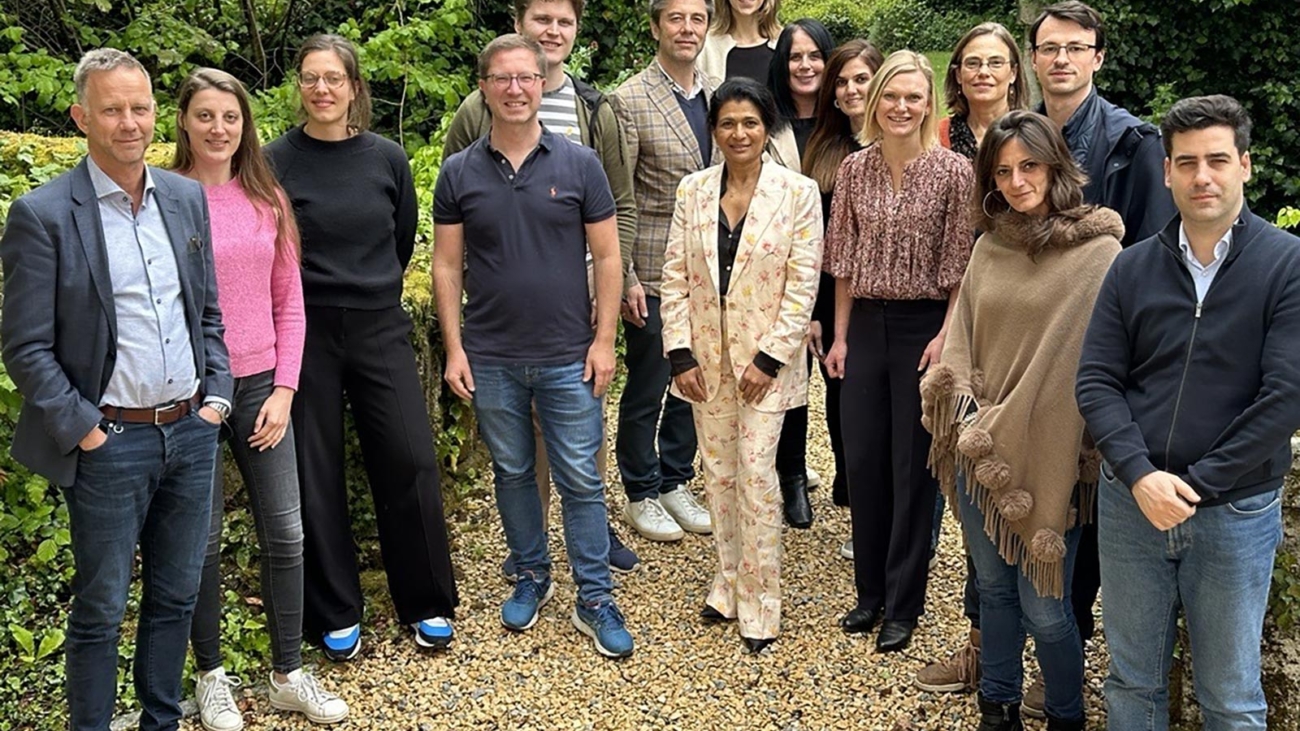
Members of the Endeavor consortium meet eachother monthly via Teams to discuss the latest status of the Endeavor study, including the to do’s, challenges, and progress. Once a year, we can also meet live to put our heads together, which contributes immensely to the progress of the study!

Over the weekend of 10 – 13 April 2025, the consortium met in beautiful Ireland. Consortium partners were present both live and online (via Teams). Members of our PPI panel also joined us, providing useful feedback and giving us an insight into their views on the project and the PhD projects arising from the Endeavor study (see more in the PPI section on the website soon).

What was discussed? Find a brief overview below of the most important topics:

    • The Endeavor study will consist of a pilot study to test the flow and afterwards a larger study (RCT). The meeting mainly focused on the current status of the pilot study (the status of ethics committee approval at all recruiting sites, the challenges that have occurred so far, the expected start date, the flow for taking and processing biological samples etc).
    • In addition, several partners presented their plan of action for the conduct of the pilot study and the follow-up study, specifically for their part of the project.
    • Also, we discussed the steps required for a smooth start of the follow-up RCT study.
    • We will work with an electronic case report form (to enter patient data) and electronic questionnaires for the patients. These were reviewed together, with members of our PPI panel also giving their feedback.
    • Our Endeavor PhD students (7 in total) also presented their projects to our PPI panel in a short pitch in plain English. The patients gave meaningful insights and feedback to help the PhD students further along the way of their project.

Thanks to this annual consortium (and PPI) meeting, we are several steps closer again to the start of our pilot study! Hope you will follow along.

 

Canva poster presentation image_update BWGE

Endeavor at the Belgian Week of Gastroenterology

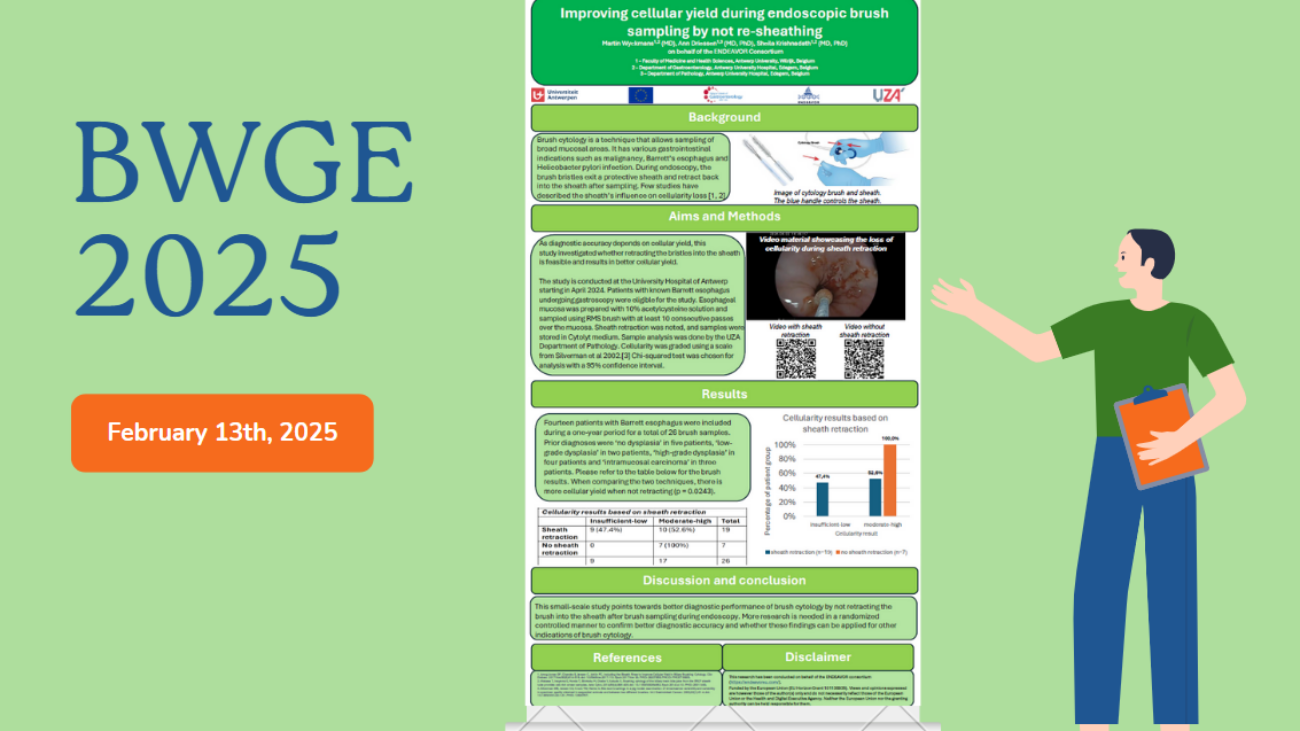
PhD student Martin Wyckmans (from the University of Antwerp, Belgium) has performed a study in collaboration with the Endeavor Chief Investigator Prof. Dr. Sheila Krishnadath. The research was presented via a poster on February 13th in Liège, Belgium at the Belgian Week of Gastroenterology (BWGE) during the Belgian Society of Gastrointestinal Endoscopy (BSGIE) session.

What was the study about? For the Endeavor study ‘brushes’ will be used to obtain cellular samples of the esophagus during endoscopy. This technique is called ‘brush cytology’. When performing brush cytology, the brush bristles exit a protective sheath and are, per standard protocol, retracted back into the sheath after sampling. This study compared the cellular yield of samples where the brush was retracted back into the sheath versus samples where the brush was not retracted back into the sheath after sampling.

Results? There was more cellular yield when not retracting the brush. As diagnostic accuracy depends on the cellular yield, this small-scale study points towards better diagnostic performance of brush cytology by not restracting the brush into the sheath after sampling during endoscopy.

Why is this important? Improving how we sample tissue of the esophagus will lead to better results for the ENDEAVOR project. By sharing this study with other researchers, research methods of other studies can be improved. This will lead to better science in a wide range of projects!

Depositphotos_115814296_L-)@

PPI Panel kick-off

We held our first Endeavor PPI panel on Thursday the 5th of September! Barrett’s Esophagus and Esophageal cancer patients from Ireland and Sweden were introduced to the project and already gave very valuable feedback regarding the questionnaires that will be used, among others. Barrett’s Esophagus experts Prof. Dr. Sheila Krishnadath, Prof. Dr. Magnus Nilsson and Prof. Jacintha O’Sullivan were present as well to guide the meeting and answer any specific questions. The info gathered from this interesting meeting will be implemented into the project in order to make it as patient-friendly as possible!

Endeavor-kick-off-group-picture

Kick-off Endeavor project

From April 25th to April 28th  2024 the Endeavour EU consortium members gathered live for the first time. It were three intensive days full of brainstorming to shape and further concretize the Endeavor trial. Great progress has been made and we hope to start the pilot/test phase of the project at the end of 2024!