

About me
Hello everyone, my name is Jennifer Kluczny. As mentioned in my first blogpost, I am a PhD candidate at the University Hospital Düsseldorf in the clinic for General, Visceral and Pediatric Surgery in the research group Experimental Surgical Oncology. I am part of the ENDEAVOR consortium, where my PhD project focuses on developing single-cell genomic approaches to better understand Barrett’s esophagus and esophageal adenocarcinoma (EAC). By studying these early cellular changes, we hope to improve how patients at risk are identified and monitored in the future.
A Day-to-Day Look at My Work in ENDEAVOR
One of the most exciting aspects of my PhD is that my work is embedded in a large international consortium. This means that my daily and weekly activities are closely connected to different recruiting clinical sites.
My research focuses on analyzing cytology brush samples collected from patients with Barrett’s esophagus lesions and early EAC. These samples contain thousands of cells collected from the esophageal lining during endoscopy. Instead of studying the tissue as a whole, my goal is to investigate individual Barrett’s cells at the single-cell level using shallow whole-genome sequencing. This allows us to detect genomic alterations that may indicate early cancer progression.
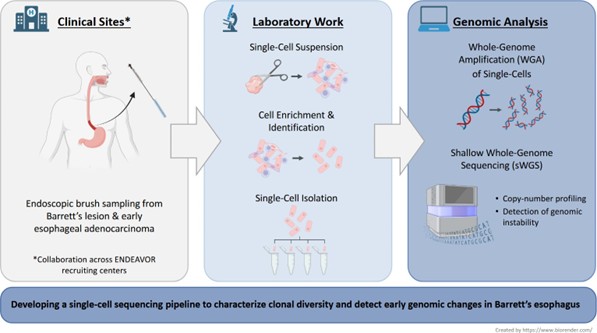
Figure: A Typical Sample Journey in My PhD Project. From endoscopic brush sampling to single- cell genomic profiling in ENDEAVOR.
Step 1: Sample Collection at ENDEAVOR Recruiting Sites
The workflow of my research starts long before the samples arrive in our laboratory. Clinical partners within the ENDEAVOR consortium collect cytology brush specimens during routine endoscopic examinations. These brushes are used to sample cells directly from Barrett’s lesions and early tumor regions in a minimally invasive way.
Step 2: Generating a single-cell suspension
After collection, the brush samples contain small tissue fragments and cell clusters, which need to be dissociated into a single-cell suspension.
Mechanical dissociation physically separates cells, while enzymatic digestion uses gentle enzymes to loosen cell-cell connections.
The goal of this step is twofold:
- To obtain individual cells for downstream single-cell analysis
- To preserve important cell surface structures (epitopes), which are necessary for later enrichment and identification of Barrett’s epithelial cells
Step 3: Enrichment of Barrett’s Cells
A crucial step is enriching the relevant cell population from the mixed sample. Besides our target cells, different cell types are co-collected during brush sampling. However, for my project, we are specifically interested in epithelial cells originating from Barrett’s tissue.
To achieve this, a semi-automated enrichment & staining workflow is used to selectively capture and identify cells that carry Barrett’s cell-associated markers. In simple terms, labeled target cells are separated from the remaining cell mixture, resulting in a more refined and biologically relevant population for downstream analysis.
As part of my routine work, I regularly review the fluorescence images to confirm cell identity, evaluate sample quality, and ensure that the enrichment process was successful. This quality control step is essential for reliable downstream single-cell analyses.
Step 4: Single-Cell Isolation
Once the cells have been characterized, the next step is single-cell isolation. Using a CellSorter system, I isolate individual cells based on their fluorescence profile. This is important for single-cell sequencing, as it allows us to study the genetic makeup of each cell independently rather than as a mixed population.
Step 5: Whole-Genome Amplification – Why Is It Necessary?
A single human cell contains only a small amount of DNA (about 6 picograms), which is not enough for sequencing. Therefore, we perform whole-genome amplification (WGA). WGA is a method that copies the entire DNA content of a single cell many times, generating enough material for sequencing while preserving the overall genomic structure. Without this step, single-cell genomic analysis would not be possible.
Step 6: Sequencing and Data Analysis of single Barrett cells
After amplification, the DNA is analyzed using shallow whole-genome sequencing (sWGS), a method that scans the entire genome at lower resolution. This approach is particularly useful for detecting copy-number alterations (CNAs), which are large gains or losses of DNA segments and important indicators of genomic instability.
Through bioinformatic analysis, we generate genomic profiles for each individual cell and assess clonal diversity, meaning how genetically different the cells within a Barrett’s lesion are. Higher clonal diversity has been linked to an increased risk of progression to esophageal adenocarcinoma.
Looking Ahead
On a monthly basis, my work alternates between laboratory work, data analysis, and collaboration with consortium partners. As the pipeline becomes more established, the focus will increasingly shift toward larger datasets and integrative analyses.
Being part of ENDEAVOR allows me to work at the interface of clinical research, molecular biology, and high-throughput genomics. It is both challenging and highly rewarding to contribute to a project that aims to improve early detection and risk assessment in Barrett’s esophagus, with the long-term vision of more precise and personalized care for patients.
Recent Developments and Upcoming Events
As part of the ENDEAVOR project, I am excited to present a poster at the ESDE 2026 conference in Cologne. This poster closely reflects the workflow described in this blog post and highlights the technical development of our pipeline, from sample collection to genomic analysis. Conferences like ESDE provide an excellent opportunity to exchange ideas, receive feedback, and connect with clinicians and researchers working in esophageal diseases.
In addition, I am very much looking forward to the upcoming annual ENDEAVOR meeting in Florence this May. These consortium meetings are always a valuable platform to discuss project progress and strengthen collaborations within our multidisciplinary network.
Jennifer